Languages
1674
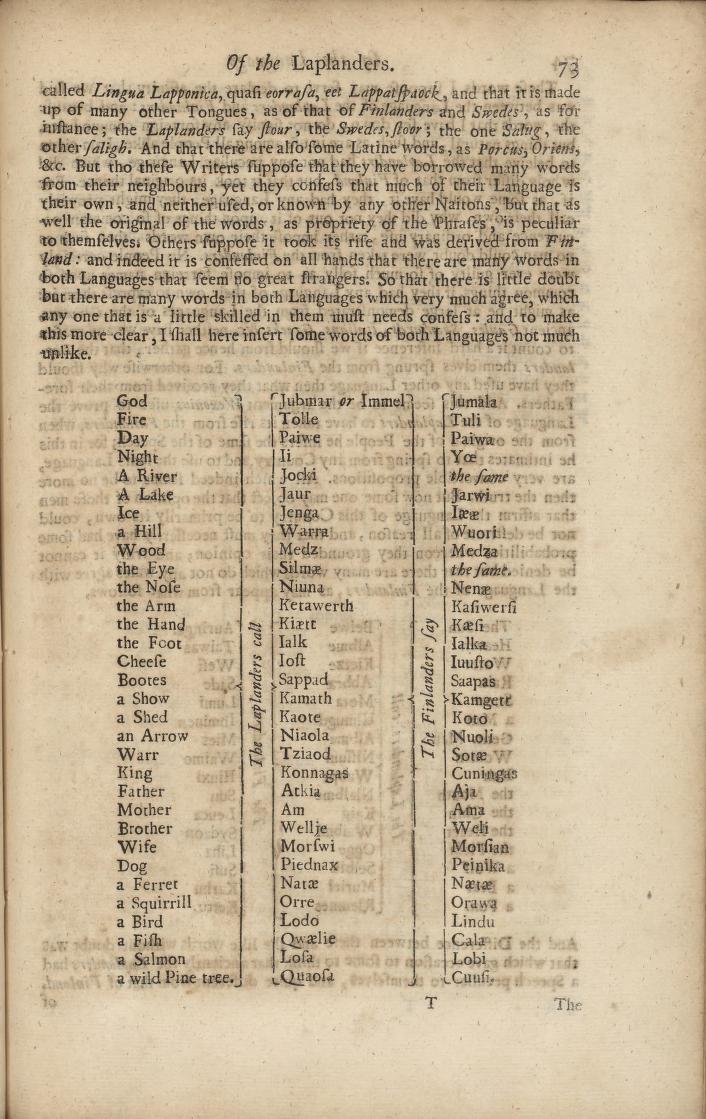
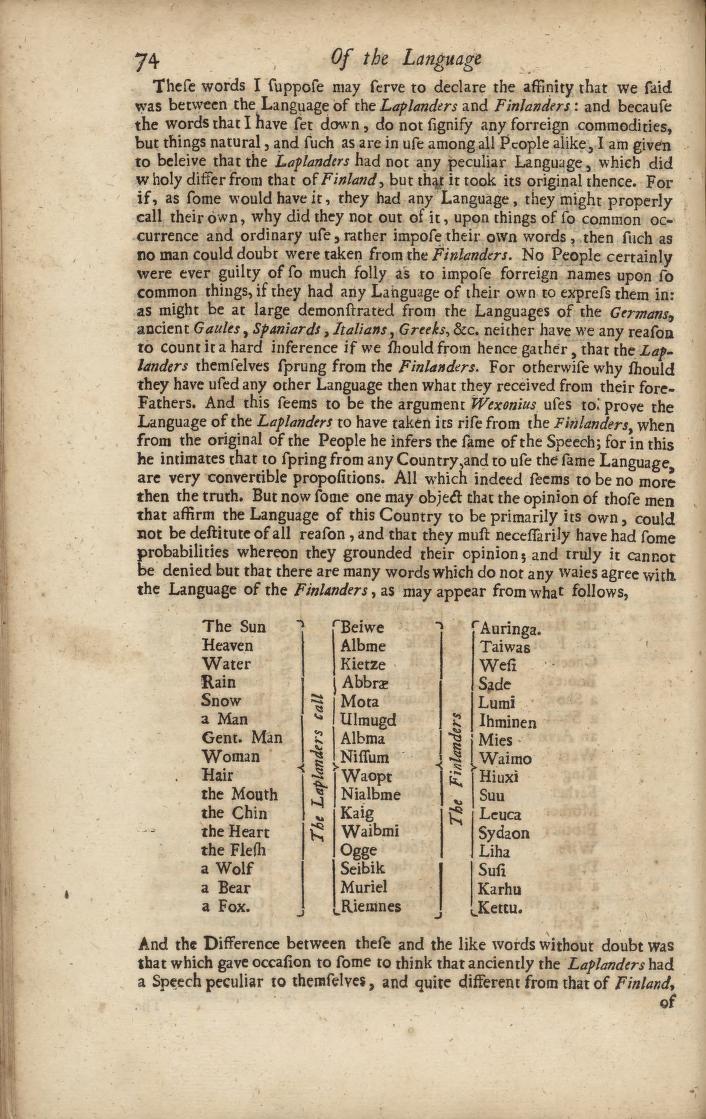
Schefferus prints words he says are the same in the Sámi language and in Finnish, and on the next page words he says are not. The spellings are his own, from 1674. He concludes that the language took its rise from the Finlanders. That is his conclusion. The words are not retyped here. (Schefferus 1674)
Dialects
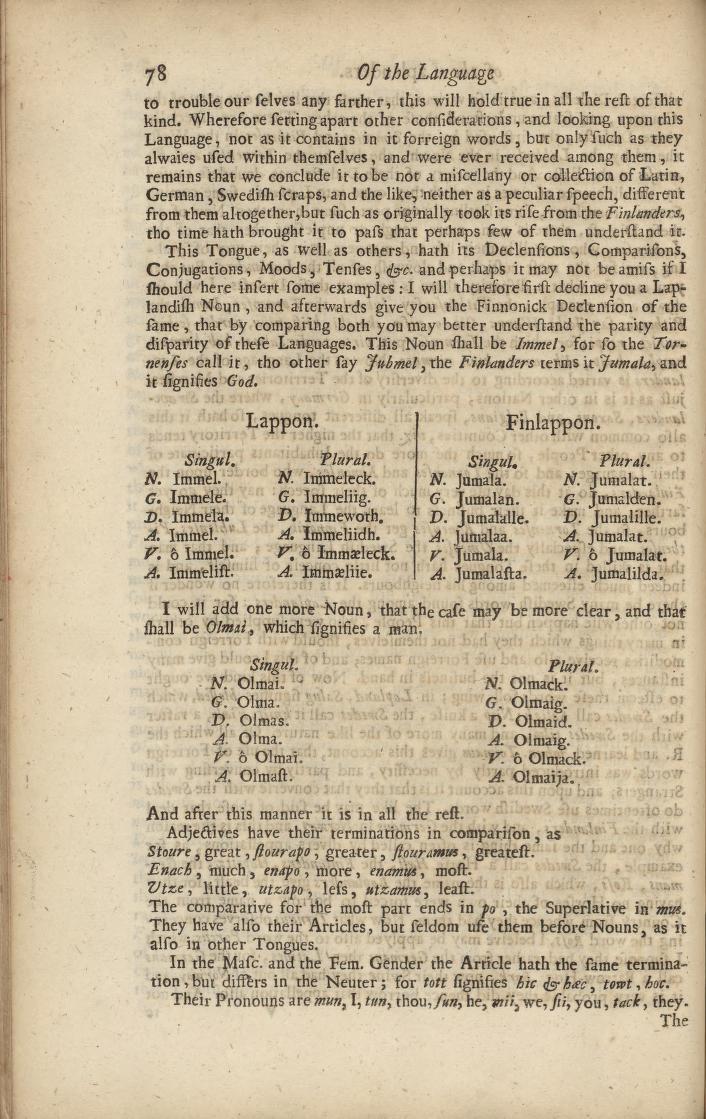
The book says the language varied so much that people of one part could scarcely understand those of another. It distinguishes three dialects: Ume and Pite in the west, Lule in the north, and Torne and Kemi in the east. In Pite, God was called Jubmel, and in Torne, Immel. Finnish Jumala is set beside it on the page. (Schefferus 1674)
Northern Sámi
Northern Sámi is spoken in Finland, Norway, and Sweden. The parliament estimates about 20,000–25,000 speakers in all, and about 2,000 in Finland. In Northern Sámi the region is called Sápmi. A printed page is missing. (Sámi Parliament of Finland)
Sámi Parliament of Finland
Inari Sámi
Inari Sámi has been spoken around Lake Inari. The parliament estimates about 400 speakers, and the number has been rising. It is the only Sámi language spoken only in Finland. In Inari Sámi the region is called Säämi. A printed page is missing. (Sámi Parliament of Finland)
Sámi Parliament of Finland
Skolt Sámi
Skolt Sámi was spoken on the Kola Peninsula and in neighbouring parts of Finland and Norway. Today most speakers live in Finland, in Inari. The parliament estimates about 300 speakers in Finland. In Skolt Sámi the region is called Sääʹmm. A printed page is missing. (Sámi Parliament of Finland)
Sámi Parliament of Finland
Nine languages
The parliament lists nine Sámi languages spoken today: Ter Sámi, Kildin Sámi, Skolt Sámi, Inari Sámi, Northern Sámi, Lule Sámi, Pite Sámi, Ume Sámi, and Southern Sámi. Akkala Sámi, spoken in Russia, is regarded as extinct as of 2003. Every Sámi language spoken in Finland is endangered. (Sámi Parliament of Finland)