The reindeer
1674
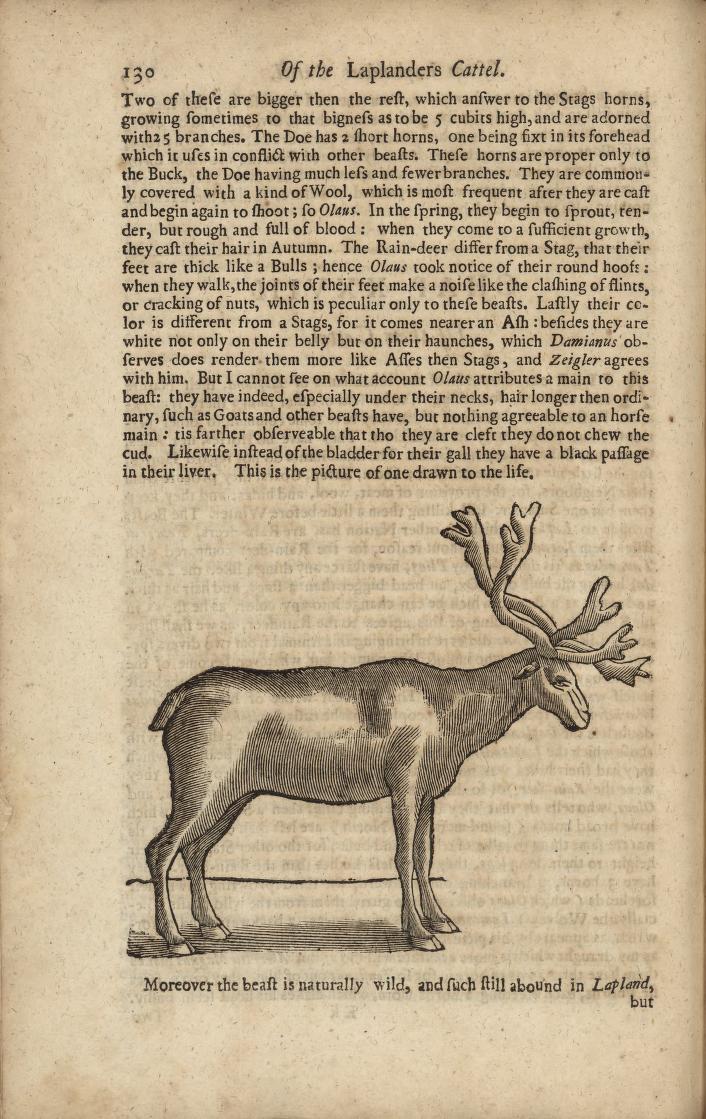
The book says horses, asses, oxen, sheep, and goats were not kept as their own. Sheep, goats, and oxen were bought from neighbours for one summer and killed before winter. It separates the reindeer from Pliny’s tarandus, and from the four horns in Lomenius. The picture is his correction. Two of the horns are larger. The hoof is thick, and the joints make a noise in walking. The colour is nearer ash than a stag’s. The animal is naturally wild, and many are tame. A third kind is bred of the wild and the tame. It is larger, draws the sledge, and is sometimes headstrong. Then the driver turns the sledge and lies under it. The rut is about St Matthew’s day. A buck killed then stinks, and they are not killed. The book says the doe calves in May, one calf. Of a hundred, not ten are barren. They are full grown in four years. Those kept for work are gelded at a year. (Schefferus 1674)
Milking
The book says there are about a hundred does to twenty bucks. They are milked kneeling, once a day, in the evening. The rest is left for the calf. The most at one time is a Swedish pint and a half. The milk is fat. A cheese takes the milk of ten reindeer. It is round and two fingers thick, and it is not pressed by hand. There is no butter. In summer the food is grass and leaves, in winter a white moss scraped from under the snow. The mark is put on the ear, not the horn, because the horn is cast. Against the wolf the forefeet are used more than the horns. The book says a reindeer never lives above ten years. (Schefferus 1674)